
Christmas Traditions in Provence: Between Family Celebration and Unique Events
Every season has its charm in Provence. But if there’s one time of year when we particularly love this region, it’s Christmas. What a joy to see ancient customs blend with more recent festivities! The whole forms a unique ensemble, making December a month rich in celebrations in the South. This is what we wish to share with you today. We take you to the heart of Christmas traditions in Provence.
Christmas Traditions in Provence, Within Families
Clearly, there are two forms of Christmas traditions in Provence. Those experienced in homes, strengthening family ties, and those that animate the region. Let’s start with the former.
The Preparation of a Provençal Christmas According to Traditions
In Provence, Christmas is not limited to the festivities surrounding December 25th. And it’s no exaggeration to say that we dedicate the entire last month of the year to it. Traditional Provençal Christmas begins as early as December 4th with a ritual unique to the region.
Saint Barbara’s Day
The majority of Christmas traditions in Provence are linked to the Christian religion. Saint Barbara’s Day is tangible proof of this. Thus, every December 4th, Provençals are invited to place wheat grains in 3 saucers (representing the Trinity), in the hope of making them sprout. Three weeks later, for Christmas, strong stalks announce a good harvest to come. The three saucers will be displayed on the table of the “Gros Souper,” which we will discuss later in the article.
The Santons of Provence
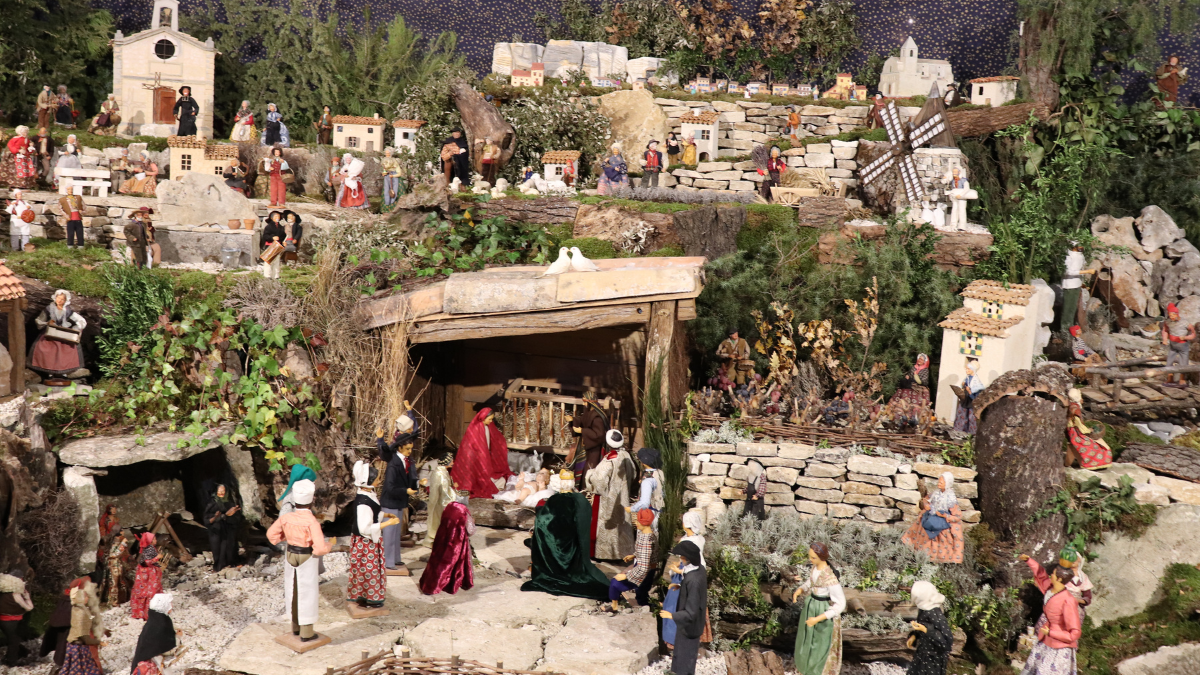
According to custom, the nativity scene must be set up in homes on the Sunday before Christmas. In older times, it was the ancestors’ nativity scene passed down from generation to generation… a tradition that is fading, as everyone wishes to own their own nativity scene. However, one habit remains strictly in force: that of adding one santon or accessory per year.
Speaking of Santons of Provence! Did you know that we owe their creation to the French Revolution? Here’s the explanation. In 1793, revolutionaries closed churches to weaken the power of the Clergy. The population, no longer able to see the Christmas nativity scene in religious buildings, decided to create miniature versions in their homes. The characters composing it were made of bread crumb or papier-mâché and were called “petits saints” (little saints); “santouns” in Provençal, which later gave the word “santon.” As for the profession of “santonnier” (santon maker), it is owed to the sculptor Louis Lagnel, who noticed one winter evening in 1798 that the clay sticking to his shoes could bring santons to life.
To return to the nativity scene, even if it is linked to Christianity, it is not solely composed of religious elements. It presents the Nativity scene, but also old trades and important figures in the history of Provence. Not to mention the accessories, just as essential as the santons. Among them, you will find:
- Provençal hills;
- vegetation (especially boxwood and cypress) representing the renewal of the winter solstice;
- flowers, berries, and aromatic plants, symbolizing purity;
- water to recall baptism;
- as well as the star, an angel, a light, and Saint Barbara’s wheat.
The Christmas Eve Vigil on December 24th in Provence
After the time of preparations comes that of celebrations. In Provence, Christmas Eve on December 24th holds a special place in the Christmas festivities. Let’s see what it consists of.
The Cacho-Fio
Celebrated in Provence according to a specific ritual, this ceremony is also found in other regions of France. In the South, it takes place as follows:
- in autumn, a log from a fruit tree is left to dry in the sun;
- on the evening of December 24th, the youngest and oldest members of the family carry this log, making three turns around the table or house;
- the log is placed in the fireplace where it is sprinkled with wine;
- an incantation is pronounced;
- the ashes of the previous year’s Cacho-fio are added to the hearth;
- the fire is lit with an olive branch.
This custom goes beyond Christmas, as the log is re-lit every evening until New Year’s Day. The ashes are kept until the following Christmas to protect against fires.
Setting the Christmas Eve Table
Traditionally, in Provence, the Christmas table is covered with 3 tablecloths, symbolizing the Trinity. The sprouted wheat is arranged, along with 3 candles, and the fine crockery is brought out. In honor of the spirit of solidarity during the holidays, a place is kept for the poor.
The Composition of the “Gros Souper”
This is the nickname given to the Christmas meal in Provence. The adjective “gros” (big/large) does not refer to the heaviness of the dishes (which are supposed not to contain meat), but rather to their number. For a successful Provençal Christmas, it is customary to plan an extensive menu to invite abundance.
The Provençal Tradition of the 13 Christmas Desserts
The most gourmet will stay with this lovely idea, while the most curious will want to know the history of the 13 Provençal desserts. As we have told you several times in this article, Christmas traditions in Provence are linked to religion, directly or indirectly. The same goes for this number of desserts, which refers to Christ’s last supper. The 13 therefore represents Jesus and the 12 apostles.
Now that the historical point is made, let’s tantalize your taste buds with the list of the 13 Provençal desserts. For a successful Christmas meal, you will need to prepare (or buy) the following dishes:
- “pompe à huile” (a type of focaccia with olive oil);
- black nougat;
- white nougat;
- dates;
- tangerines or oranges;
- winter melon (though it is becoming rarer);
- grapes;
- pears;
- candied fruits or quince paste;
- dried figs;
- raisins;
- almonds;
- walnuts or hazelnuts.
That said, the list may vary depending on the towns or families.
📌 Now that you are fully immersed in the Christmas spirit, how about making it even more festive? Book at our campsite before January 15, 2025, and get up to 15% off during Early Booking!
Christmas Events in Provence
It’s impossible to miss the Christmas spirit in December in our beautiful region. It’s simply everywhere. Here’s how it manifests itself.
Christmas Nativity Scenes in Provence
After talking about the nativity scenes in our homes, let’s move on to the nativity scenes that animate the region during December. Some are larger versions than those in homes and can be installed in churches or any other building. Others are true living spectacles. Let’s see the ones not to miss at the end of 2024.
The Gassin Nativity Scene
Don’t hesitate to visit the tourist office of this charming village in the Var. There you can discover a true work of art. Indeed, from December 8, 2024, to February 2, 2025, a Neapolitan nativity scene by artist Christian Léandre Ganga will be exhibited there. Enough to dazzle you!
The Life-Sized Nativity Scene in Villars
Our campsite, Les Chênes Blancs, is located in the heart of the Luberon. If you come for a stay there, you will have plenty to do in the surroundings; you can notably discover the famous ochres of the Provençal Colorado. It is in the middle of these spectacular cliffs that the village of Villars will present a scenography of the Nativity.
📌 We take this opportunity to inform you that our group owns another campsite in the Luberon. You have no more excuses not to discover this beautiful region of France.
Santon Fairs and Christmas Markets
Christmas markets spring up all over France in December. And our beautiful department of Vaucluse is no exception. Christmas markets in Provence don’t present anything very different from other regions, apart from their excellent gastronomy. Often, they are visited as much to find gifts as to awaken one’s taste buds.
📌 Looking for a Christmas market in the Vaucluse? Make your selection from this list.
In addition to Christmas markets, from mid-November, santon fairs appear in the region. As their name suggests, they are dedicated to the characters and accessories that enliven the nativity scenes. From tiny santons to large ones, there’s something for everyone.
Live Shows Related to Christmas Traditions
Earlier, we talked about the living nativity scene of Villars. But many other shows animate our beautiful Provençal villages during the Christmas season. We present two of them here.
The Cacho-Fio of Séguret
In this village of the Vaucluse, you will have the opportunity to attend, on December 24th, a public version of the Cacho-fio described in the first part of this article. This event will be followed by the show entitled “Mystère des Bergers de Séguret” (Mystery of the Shepherds of Séguret) presenting three scenes of the Nativity. A midnight mass celebrated in Provençal will conclude this Christmas Eve.
The Shepherds of Les Baux-de-Provence
Among our neighbors in Les Baux-de-Provence, in the Alpilles (where you can discover our Camping La Vallée Heureuse), the pastoral tradition is honored at Christmas. Every day of the school holidays, the flock of sheep and ewes crosses the village to reach the church square and its nativity scene setting. This is an opportunity to discuss transhumance with the shepherds.
Our tour of Christmas traditions in Provence ends here. We hope this has made you want to discover our beautiful region. Even if our campsite cannot welcome you during the Christmas period, we wish to give you a gift and make your Christmas celebrations more festive. To do this, book at our campsite before January 15, 2025, and get up to 15% off during Early Booking!
Sources :
https://www.ventouxprovence.fr/actualites/traditions-de-noel-en-provence.html
https://www.les-plus-beaux-villages-de-france.org/fr/nos-idees-sejours/noel-dans-les-plus-beaux-villages-de-france/noel-en-provence
https://www.provenceguide.com/les-tops-du-vaucluse/comment-fete-t-on-noel-en-provence-traditions-et-fetes-provence-guide/